How to map what's actually happening
Don't start with a whiteboard. Start with a Tuesday. Here is the shadow-a-colleague technique we teach every new operator.
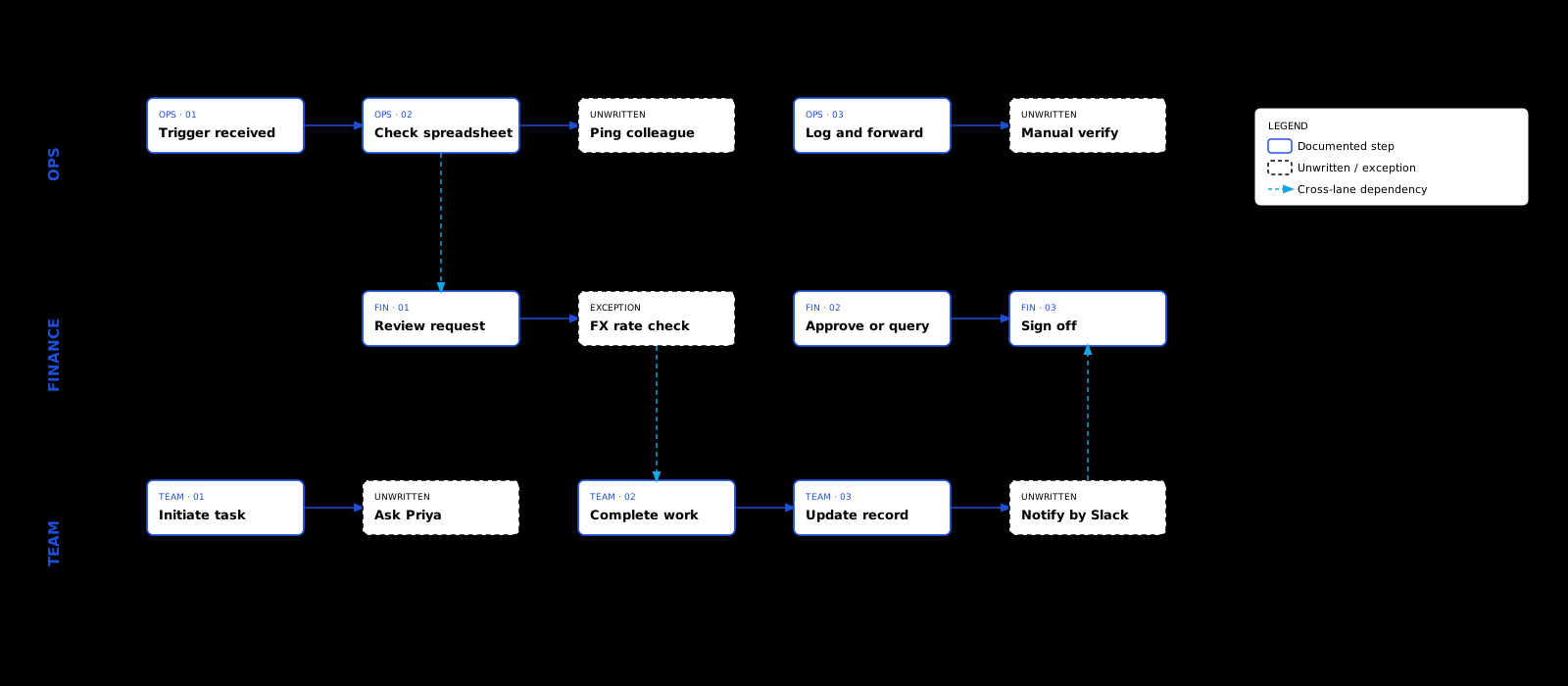
The first thing most teams do, when someone finally decides a process needs mapping, is book a meeting room and fill a whiteboard. People with markers draw boxes and arrows. Someone takes a photograph. The photograph becomes a diagram. The diagram becomes the map. This is, in most cases, a very efficient way to produce a document that is wrong before it is printed.
The problem is not the whiteboard itself. The problem is what people do when you ask them to describe their work out loud, in a group, without doing it. They describe the version they would like to do, or the version they believe they should be doing, or the simplified version that sounds sensible when narrated. They leave out the exception branches because those feel embarrassing, or they forget them entirely because exceptions, by definition, are not the thing they spend most of their time thinking about. They omit the workarounds because workarounds carry an implication of imperfection, and nobody wants to say “and then I copy it into a spreadsheet because the system is wrong” in front of a manager and a photographer. The map that results is the ideal. The ideal is not the territory.
01 · The lift problemWhy the whiteboard lies
There is a well-documented phenomenon in ergonomics research sometimes called the lift problem: if you ask workers to describe how they lift a heavy object, they will describe the technique they were trained to use. If you observe them actually lifting a heavy object, they will do something quite different. The gap is not dishonesty; it is the natural distance between abstract description and embodied habit. People know, in the abstract, how something should be done. Their hands know, in practice, how it is done. These are different kinds of knowledge, stored differently, retrieved by different cues.
Process mapping runs into the same gap. The whiteboard room is an abstract environment. It retrieves abstract knowledge. What you want is situated knowledge, the kind that lives in the hands and the habits and the actual sequence of screens that someone opens on a specific morning when the work is in front of them.
A finance team at a Leeds-based professional-services firm had a quarterly close process that, on paper, took approximately two days. The documented version had eight steps, each with a named owner and a clear input and output. The operations director was confident in it. She had reviewed it herself four months earlier.
When we asked to observe the actual close rather than read about it, the picture was different. The real process had fourteen steps, not eight. Six of the additional steps were exception branches: things that happened when data arrived late from a particular business unit, when the FX rates from the overnight feed did not match the manual check, when the consolidation tool produced a value the team did not trust and had learnt to verify against a separate spreadsheet before signing off. None of those branches appeared in the documented version. They were not secret. The people doing the close knew them perfectly. They simply had not surfaced in the whiteboard session eight months earlier, because in that meeting nobody had been doing the close.
The documented process was eight steps, each of which was correct. The real process was fourteen steps, six of which the business did not formally know it was running.
02 · Shadow, don't interviewWatch a Tuesday
The technique we use is simple and produces better results than anything involving a whiteboard: pick a mid-tenure person, on an ordinary day, and watch them work. Do not ask them questions until after. Say very little. Take notes.
Mid-tenure matters. Someone who joined recently has not yet developed the workarounds and will follow the documented process, which is not what you are trying to capture. Someone very senior has usually stopped doing the work personally; they manage the process, which is a different thing entirely. You want someone who has been in the seat long enough to have encountered the edge cases and developed their own way of handling them, but not so long that the habits have become so automatic they cannot be observed. In most teams, that means somebody with between eighteen months and four years in the role.
The ordinary day matters, too. The Monday after a bank holiday is not an ordinary day. The last day of the month is not an ordinary day. An ordinary day is a Tuesday in the middle of a normal week, when nothing special is happening and the work is just the work. That is when you see the actual process, not the holiday-cover version or the end-of-period scramble.
Silence matters most of all. The moment you ask “why are you doing that?”, the person stops doing it and starts explaining it, which retrieves a different kind of knowledge. Let them run through the whole thing first. Note every point where they switch tabs, send a message, open a file, pause to think, or do something that does not appear in the documented steps. The pauses are especially important. A pause usually means either a decision, a check, or an interruption; all three are places where the real complexity lives.
After the session, go through your notes together. Ask about the things you wrote down. This is when the explanation happens, and it is far more accurate than anything produced in advance, because it is anchored to specific things that actually occurred an hour ago rather than to a general description of what usually happens.
One thing to watch for: the correction. This is the moment when the person does something, pauses, and then changes it. The correction is a near-miss. It is the place where the undocumented rule lives, the constraint that the person has internalised well enough to catch themselves when they violate it, but not formalised enough to have written down. Corrections are gold. Ask about every single one.
· · ·
The map you produce from a shadow session will look nothing like the whiteboard version. It will be messier. It will have more steps, more branches, more names, more tabs. It will also be true, which the whiteboard version was not. A messy true map is more useful than a tidy wrong one.
The next article in this series, on phantom processes, explores what happens when those unwritten branches carry real weight for the business, and what it costs when the person who holds them in memory finally leaves.